BPC-157
Also known as: Body Protection Compound 157 · PL 14736 · Bepecin
A synthetic fifteen-residue peptide whose sequence derives from a protein found in human gastric juice. Widely studied in rodent injury models; the human evidence base is very thin and it is not an approved medicine anywhere.
Development status: Preclinical — laboratory and animal studies only
Identifiers and molecular characteristics
- CAS number
- 137525-51-0Source: Wikipedia infobox and Sigma-Aldrich catalogue (free base). Cayman Chemical lists 1628202-19-6 for the acetate salt. · checked 2026-10-11Salt forms carry different CAS numbers. Confirm which form a certificate of analysis describes.
- Molecular formula
- C62H98N16O22Source: Sigma-Aldrich and Cayman Chemical catalogue records (in agreement) · checked 2026-10-11
- Molecular mass
- ≈1419.5 g/mol (free base)Source: Sigma-Aldrich (1419.54, free-base basis) · checked 2026-10-11
- Amino-acid sequence
- GEPPPGKPADDAGLVSource: Sigma-Aldrich product record, given in both one-letter and three-letter notation · checked 2026-10-11
- PubChem CID
- Not verified
Identifiers are published only with a source and a check date. Fields marked “not verified” have not yet been confirmed against a primary source — we show the gap rather than an unchecked figure. Always confirm against the certificate of analysis for the specific lot you hold.
Biological targets
- Mechanism not definitively established; nitric oxide pathway and growth factor signalling proposed
Mechanism of action
No single receptor has been established. Published hypotheses include modulation of nitric oxide signalling, effects on angiogenesis via VEGF-related pathways, and interaction with growth factor signalling. The honest position is that the mechanism remains unresolved, and sources asserting a definite one are going beyond the evidence.
Research evidence and its limits
A substantial rodent literature across gastrointestinal, tendon, muscle and nerve injury models, much of it from a small number of collaborating groups — a concentration that is itself a limitation when weighing reproducibility. Human data are extremely limited. Animal findings in injury models do not establish human efficacy.
Safety considerations
No regulatory authority has assessed this compound as safe or effective for any human indication. The published record is predominantly laboratory and animal work, which does not establish human safety. Supplied and discussed here strictly as a laboratory research material. Not a medicine, not for human or veterinary administration, and nothing on this page should be read as a dosing, treatment or safety recommendation.
Analytical identification and quality testing
Identity by high-resolution mass spectrometry against the expected mass, purity by RP-HPLC with UV detection. For a sequence-defined peptide, enzymatic digestion followed by peptide mapping gives far stronger identity evidence than mass alone, because isomers and closely related sequences can share a mass. BPC-157 is commonly supplied as an acetate or trifluoroacetate salt, so stated mass depends on which form is described — a frequent source of confusion when comparing certificates.
Regulatory status
Not approved as a medicine in any jurisdiction known to this entry as of 11 October 2026. It appears on prohibited-substance lists in some sporting contexts. Verify current status with the relevant authority.
Frequently asked questions
Is BPC-157 a naturally occurring peptide?
The sequence is described as deriving from a protein present in human gastric juice, but the fifteen-residue peptide itself is synthetic. It is not isolated from a natural source.
Why do different suppliers quote different molecular masses?
Because they are describing different salt forms. The free base and the acetate or trifluoroacetate salts have different masses and different CAS numbers. Always check which form the certificate of analysis refers to.
References
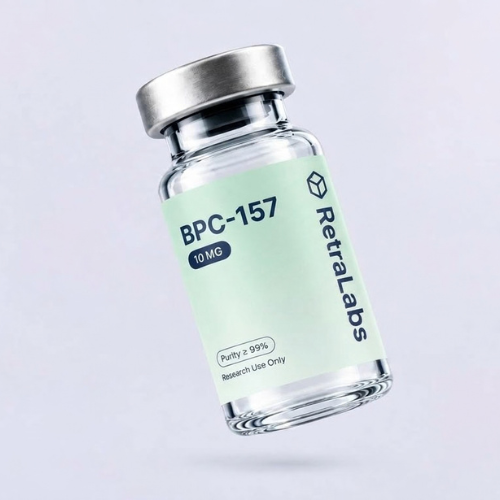
Available from RetraLabs
BPC-157
10 MG · 99.3% · supplied for laboratory research use only.
View product detailsRelated compounds
TB-500 (thymosin beta-4 fragment)
A synthetic peptide corresponding to an active region of thymosin beta-4. Frequently conflated with full-length thymosin beta-4, which is a different and longer molecule — the two should not be treated as interchangeable.
GHK-Cu
A complex of the tripeptide glycyl-histidyl-lysine with copper(II). Classified here as a metal–peptide complex rather than a peptide, because the copper ion is integral to the species and to its reported chemistry.
Entry last reviewed 2026-10-11. Regulatory status and scientific understanding change; verify against primary sources before relying on anything here.