Cagrilintide
Also known as: AM833
A long-acting amylin receptor agonist studied both alone and in combination with GLP-1 receptor agonists. Investigational; no marketing authorisation recorded as of this entry’s review date.
Development status: Investigational — studied in human trials
Identifiers and molecular characteristics
- CAS number
- Not verified
- Molecular formula
- Not verified
- Molecular mass
- Not verified
- Amino-acid sequence
- Not verified
- PubChem CID
- Not verified
Identifiers are published only with a source and a check date. Fields marked “not verified” have not yet been confirmed against a primary source — we show the gap rather than an unchecked figure. Always confirm against the certificate of analysis for the specific lot you hold.
Biological targets
- Amylin receptors (AMY1–AMY3)
- Calcitonin receptor
Mechanism of action
Amylin is co-secreted with insulin from pancreatic beta cells and signals through calcitonin-receptor-based complexes. Cagrilintide is engineered for extended duration relative to native amylin, which is rapidly cleared and prone to aggregation.
Research evidence and its limits
Studied in registered human clinical trials, including combination work with semaglutide. Peer-reviewed results exist; the compound remains investigational.
Safety considerations
No regulator has assessed cagrilintide as safe and effective for any indication. Supplied and discussed here strictly as a laboratory research material. Not a medicine, not for human or veterinary administration, and nothing on this page should be read as a dosing, treatment or safety recommendation.
Analytical identification and quality testing
Mass spectrometry and RP-HPLC. Amylin analogues are formulated with attention to aggregation behaviour, so appearance and solution clarity are meaningful observations alongside instrumental analysis.
Regulatory status
No marketing authorisation recorded as of 11 October 2026. Verify against the relevant authority.
Frequently asked questions
How does amylin signalling differ from GLP-1 signalling?
They are separate receptor systems. Amylin acts through calcitonin-receptor-based complexes; GLP-1 acts at its own class B GPCR. This is why the two are studied in combination — the mechanisms are complementary rather than redundant.
References
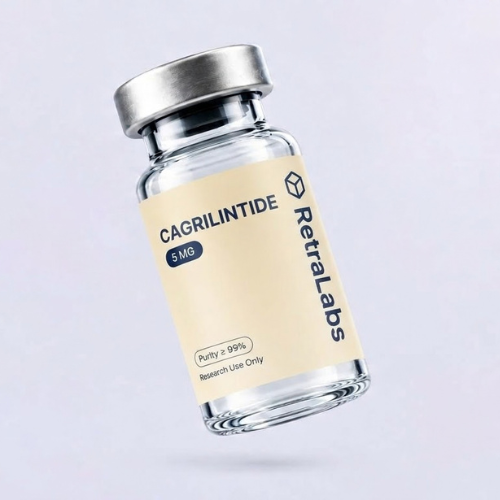
Available from RetraLabs
Cagrilintide
5 MG · 99.1% · supplied for laboratory research use only.
View product detailsRelated compounds
Semaglutide
A long-acting GLP-1 receptor agonist, structurally derived from human GLP-1 with modifications that resist enzymatic degradation and extend circulating half-life. Approved as a medicine in multiple jurisdictions.
Pramlintide
A synthetic analogue of human amylin with proline substitutions that prevent the aggregation which makes native human amylin impractical as a therapeutic.
Retatrutide
An engineered single-molecule agonist at the GIP, GLP-1 and glucagon receptors, developed by Eli Lilly under the code LY3437943. It is investigational: it has been studied in human trials but is not an approved medicine in any jurisdiction as of this entry’s review date.
Entry last reviewed 2026-10-11. Regulatory status and scientific understanding change; verify against primary sources before relying on anything here.