Epithalon
Also known as: epitalon · AEDG peptide
A synthetic tetrapeptide (Ala-Glu-Asp-Gly) associated with research from a single Russian research tradition into pineal peptide preparations and ageing.
Development status: Preclinical — laboratory and animal studies only
Identifiers and molecular characteristics
- CAS number
- Not verified
- Molecular formula
- Not verified
- Molecular mass
- Not verified
- Amino-acid sequence
- Not verified
- PubChem CID
- Not verified
Identifiers are published only with a source and a check date. Fields marked “not verified” have not yet been confirmed against a primary source — we show the gap rather than an unchecked figure. Always confirm against the certificate of analysis for the specific lot you hold.
Biological targets
- Reported effects on telomerase expression
Mechanism of action
Reported in its source literature to influence telomerase activity and pineal function. Mechanistic detail is thin and independent confirmation is limited.
Research evidence and its limits
A literature concentrated in a narrow set of sources, with limited independent replication. Claims about lifespan extension in humans are not supported by controlled trials.
Safety considerations
No regulatory authority has assessed this compound as safe or effective for any human indication. The published record is predominantly laboratory and animal work, which does not establish human safety. Supplied and discussed here strictly as a laboratory research material. Not a medicine, not for human or veterinary administration, and nothing on this page should be read as a dosing, treatment or safety recommendation.
Analytical identification and quality testing
Identity by high-resolution mass spectrometry against the expected mass, purity by RP-HPLC with UV detection. Tandem MS sequencing or peptide mapping gives stronger identity evidence than mass alone.
Regulatory status
Not an approved medicine in any major jurisdiction.
Frequently asked questions
Is there human evidence that epithalon extends lifespan?
No controlled human trial establishes that. The claim traces to a small body of work from one research tradition, and should be read with that limitation in view.
References
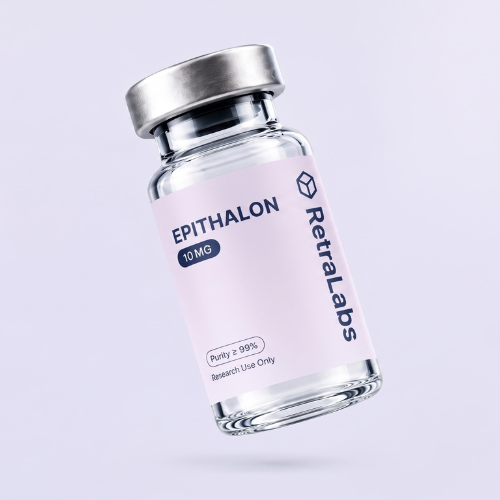
Available from RetraLabs
Epithalon
10 MG · 99.2% · supplied for laboratory research use only.
View product detailsRelated compounds
FOXO4-DRI
A D-retro-inverso peptide designed to disrupt the FOXO4–p53 interaction, studied as a senolytic in laboratory models.
MOTS-c
A mitochondrial-derived peptide encoded within the mitochondrial 12S rRNA gene rather than the nuclear genome — a class of molecule only recognised comparatively recently.
Entry last reviewed 2026-10-11. Regulatory status and scientific understanding change; verify against primary sources before relying on anything here.