Retatrutide
Also known as: LY3437943 · GGG tri-agonist · triple agonist
An engineered single-molecule agonist at the GIP, GLP-1 and glucagon receptors, developed by Eli Lilly under the code LY3437943. It is investigational: it has been studied in human trials but is not an approved medicine in any jurisdiction as of this entry’s review date.
Development status: Investigational — studied in human trials
Identifiers and molecular characteristics
- CAS number
- 2381089-83-2Source: MedChemExpress, Selleck Chemicals and ChemicalBook catalogue entries (cross-checked) · checked 2026-10-11
- Molecular formula
- C221H342N46O68Source: MedChemExpress, Selleck Chemicals, ChemicalBook (three sources in agreement) · checked 2026-10-11
- Molecular mass
- ≈4731.3 g/molSource: MedChemExpress (4731.33) · checked 2026-10-11Sources disagree in the first decimal place: MedChemExpress gives 4731.33 and Bioscience.co.uk gives 4732.09. Salt forms differ again. Treat the figure as approximate and confirm against the certificate of analysis for the specific lot.
- Amino-acid sequence
- Not verified
- PubChem CID
- Not verified
Identifiers are published only with a source and a check date. Fields marked “not verified” have not yet been confirmed against a primary source — we show the gap rather than an unchecked figure. Always confirm against the certificate of analysis for the specific lot you hold.
Biological targets
- GIP receptor
- GLP-1 receptor
- Glucagon receptor
Mechanism of action
Retatrutide is designed to engage three class B G-protein-coupled receptors with a single molecule. GLP-1 and GIP receptor activity relate to glucose-dependent insulin secretion and gut-brain satiety signalling; glucagon receptor agonism is associated in the literature with increased energy expenditure. Combining the three in one peptide is an attempt to recruit complementary mechanisms, and the balance of potency between the receptors is a deliberate design parameter rather than an accident.
Research evidence and its limits
Retatrutide has been evaluated in registered human clinical trials sponsored by Eli Lilly, with results reported in peer-reviewed journals. This places it well ahead of most compounds in this encyclopedia in terms of evidence quality. It nevertheless remains investigational: completion of trials is not approval, and published trial results describe outcomes in a defined study population under supervision, which is not the same as an established safety profile for general use.
Safety considerations
No regulator has assessed retatrutide as safe and effective for any indication. Published trials report adverse events, predominantly gastrointestinal, within supervised settings. Long-term data are limited by the compound’s short development history. Supplied and discussed here strictly as a laboratory research material. Not a medicine, not for human or veterinary administration, and nothing on this page should be read as a dosing, treatment or safety recommendation.
Analytical identification and quality testing
Identity for a peptide of this size is normally established by high-resolution mass spectrometry against the expected monoisotopic or average mass, with RP-HPLC for purity and a UV or ELSD detector for quantitation. Because several structurally similar incretin analogues exist, mass alone is weak evidence of identity — co-elution against a reference standard, or peptide mapping after enzymatic digestion, is substantially stronger.
Regulatory status
As of 11 October 2026 this entry records no marketing authorisation for retatrutide from the US FDA, the EMA or India’s CDSCO. Regulatory status changes; verify against the relevant authority before relying on this statement.
Frequently asked questions
Is retatrutide an approved medicine?
No. It is an investigational compound that has been studied in human clinical trials. No marketing authorisation is recorded as of this entry’s review date.
Why is it described as a triple agonist?
Because one molecule is engineered to activate three separate receptors — GIP, GLP-1 and glucagon — rather than the single receptor that earlier incretin analogues target.
Why does the molecular mass on this page carry a caveat?
Because reputable catalogue sources quote slightly different values, and salt forms differ again. We record the disagreement rather than picking one and presenting it as settled.
References
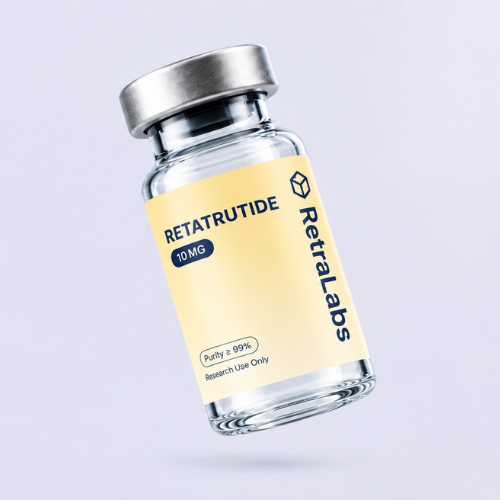
Available from RetraLabs
Retatrutide
10 MG · 99.2% · supplied for laboratory research use only.
View product detailsRelated compounds
Tirzepatide
A dual agonist at the GIP and GLP-1 receptors. Unlike most compounds in this encyclopedia, tirzepatide has received marketing authorisation as a medicine in several jurisdictions, which means a regulator has reviewed a full clinical dossier for it.
Semaglutide
A long-acting GLP-1 receptor agonist, structurally derived from human GLP-1 with modifications that resist enzymatic degradation and extend circulating half-life. Approved as a medicine in multiple jurisdictions.
Cagrilintide
A long-acting amylin receptor agonist studied both alone and in combination with GLP-1 receptor agonists. Investigational; no marketing authorisation recorded as of this entry’s review date.
Entry last reviewed 2026-10-11. Regulatory status and scientific understanding change; verify against primary sources before relying on anything here.