TB-500 (thymosin beta-4 fragment)
Also known as: TB4 fragment · Tβ4 active fragment
A synthetic peptide corresponding to an active region of thymosin beta-4. Frequently conflated with full-length thymosin beta-4, which is a different and longer molecule — the two should not be treated as interchangeable.
Development status: Preclinical — laboratory and animal studies only
Identifiers and molecular characteristics
- CAS number
- Not verified
- Molecular formula
- Not verified
- Molecular mass
- Not verified
- Amino-acid sequence
- Not verified
- PubChem CID
- Not verified
Identifiers are published only with a source and a check date. Fields marked “not verified” have not yet been confirmed against a primary source — we show the gap rather than an unchecked figure. Always confirm against the certificate of analysis for the specific lot you hold.
Biological targets
- Actin binding (the parent protein sequesters G-actin)
Mechanism of action
Thymosin beta-4 is an actin-sequestering protein involved in cytoskeletal dynamics and cell migration. The fragment sold as TB-500 corresponds to a region associated with that activity. Whether a short fragment reproduces the parent protein’s biology is a genuinely open question.
Research evidence and its limits
Preclinical literature on thymosin beta-4 exists in wound healing and cardiac models. Evidence specific to the fragment is thinner than evidence for the full-length protein, and the two are routinely cited interchangeably in non-scientific sources, which inflates the apparent evidence base.
Safety considerations
No regulatory authority has assessed this compound as safe or effective for any human indication. The published record is predominantly laboratory and animal work, which does not establish human safety. Supplied and discussed here strictly as a laboratory research material. Not a medicine, not for human or veterinary administration, and nothing on this page should be read as a dosing, treatment or safety recommendation.
Analytical identification and quality testing
Identity by high-resolution mass spectrometry against the expected mass, purity by RP-HPLC with UV detection. For a sequence-defined peptide, enzymatic digestion followed by peptide mapping gives far stronger identity evidence than mass alone, because isomers and closely related sequences can share a mass.
Regulatory status
Not an approved medicine. Appears on prohibited-substance lists in some sporting contexts.
Frequently asked questions
Is TB-500 the same as thymosin beta-4?
No. Thymosin beta-4 is a 43-residue protein; TB-500 refers to a short synthetic fragment of it. Literature about one does not automatically apply to the other.
References
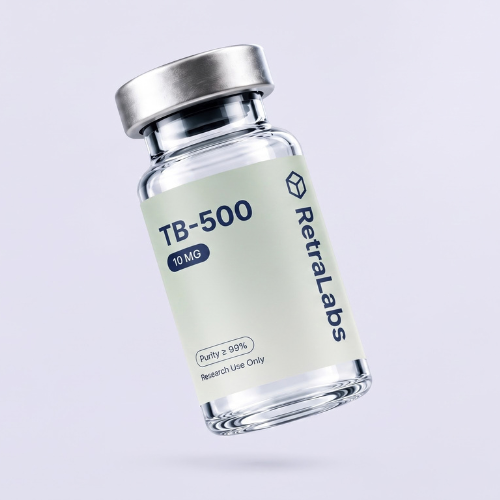
Available from RetraLabs
TB-500
10 MG · 99.1% · supplied for laboratory research use only.
View product detailsRelated compounds
BPC-157
A synthetic fifteen-residue peptide whose sequence derives from a protein found in human gastric juice. Widely studied in rodent injury models; the human evidence base is very thin and it is not an approved medicine anywhere.
Thymosin alpha-1
A 28-residue thymic peptide with immunomodulatory activity, approved in some jurisdictions as thymalfasin.
Entry last reviewed 2026-10-11. Regulatory status and scientific understanding change; verify against primary sources before relying on anything here.